Our above given available dates are only for small private groups and solo trips. We don’t organize group joining tours.
Please note: This tour a fully guided hike and you will be accompanied by our highly skilled mountain trek guides. It is a remote terrain high altitude adventure therefore, you should be physically and mentally fit. You should be trained at your home at least 8 week before your trek departure date. We can provide you a pre-training ideas if needed.
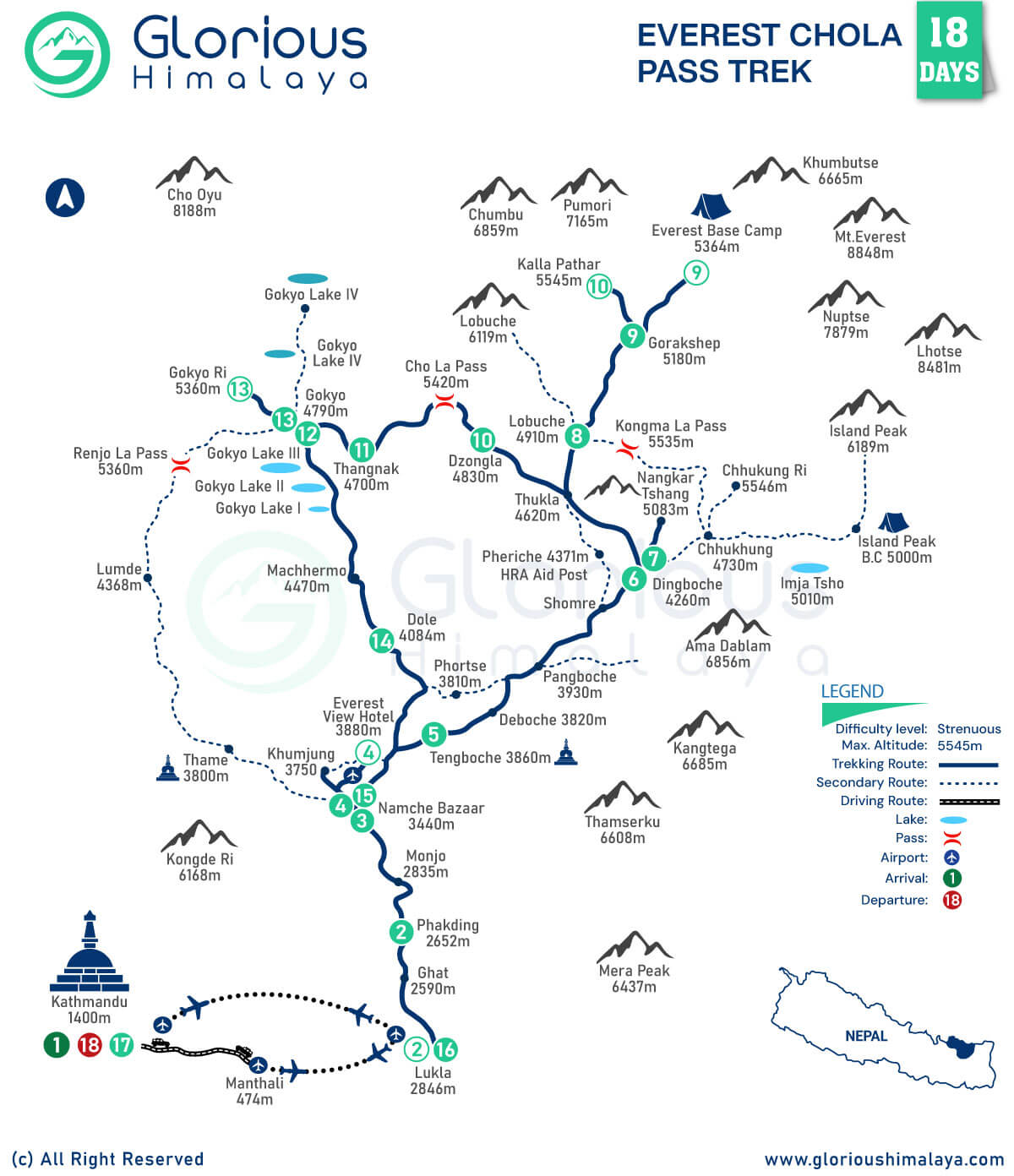
The Everest Base Camp Trek with Cho La Pass is an exciting adventure in the Khumbu Valley of Nepal, combining exceptional natural beauty, unique culture, and high altitude challenges. The trek combines an iconic destination, EBC, with a high altitude pass among the Everest Three Passes trek, Chola Pass, via Gokyo lakes. Here are the major attractions of this remarkable journey:
Flight to Lukla
The journey to EBC Chola Pass starts with a thrilling beginning with a scenic flight from Kathmandu to Lukla. The Airport is a Tenzing Hillary Airport and is also known as the most dangerous Airport in the world. It offers stunning aerial views of the Himalayan range. Moreover, the journey provides a glimpse of Nepal’s landscape, from bustling Kathmandu to a quiet Himalayan area.
Namche Bazaar
Namche Bazaar is a well-known town in the Everest region and the administrative center and Capital of the Khumbu region. The village serves as the gateway to Everest and an ideal acclimatization point. Markets fill Namche with all the modern facilities, from restaurants to hotels to ATMs and more. Along with that, it has three small museums, a stupa, and a monastery. Khumbu village and Syangboche Airport above Namche are major reasons for spending a day in the village for acclimatization.
Read more about Namche Bazaar Click Here.
Elevation
Namche Bazaar is 3,440 meters/ 11,286 feet above sea level, making it a key stop point on the journey to higher altitudes in the Everest region. Above 3000m, the location is ideal for acclimatization, letting the trekker’s body adjust to changes in temperature and prepare for upcoming higher elevations.
Gokyo Valley
The charming Gokyo Valley, at an elevation of 4,750m, is a small yet beautiful village in the Everest region. The valley is home to the stunning Gokyo Lakes, which attract trekkers from worldwide. The lakes are sacred and have religious significance, setting against the towering peaks and adding to the journey’s attraction. Moreover, the valley is the base of the Gokyo Ri, a prominent viewpoint.
Gokyo Lakes
Gokyo Lakes are a series of six oligotrophic lakes in the Sagarmatha National Park. Lying between the elevation of 4,700–5,000 m (15,400–16,400 ft), the lakes are the world’s highest freshwater lake system, with a surface area of 196.2 ha (485 acres). In the Khumjung Village Development Committee of Solukhumbu District, the lakes hold great significance in the Gokyo Valley and attract thousands of visitors yearly. Ngozumpa Glacier is the primary source of the lakes. Moreover, locals believe the lakes are home to “Nag Devta” (Snake God).
Tengboche Monastery
Tengboche monastery at the Tengboche village is the largest monastery in the Khumbu region, holding a great religious significance and offering a peaceful experience. Built in 1916 by Lama Gulu, the monastery offers an astonishing panorama of Mount Everest, Tawache, Nuptse, Lhotse, Ama Dablam, and Thamserku. Situated at 3867m above sea level, the monastery is a spiritual pillar of faith in the Everest region. The monastery lies on the primary route to Everest Base Camp and is a night stay point where trekkers can enjoy morning and evening chanting and worship.
Sagarmatha National Park
The major attraction of the trek to Everest Base Camp Cho La pass is Sagarmatha National Park, where the journey takes place. The national is a protected area in the Himalayas of northeast Nepal, spreading over an area of 1,148 square Km. It is a UNESCO World Heritage Site and home to rare wildlife like red panda, Himalayan Tahr, and Snow Leopard. Likewise, the park has a diverse ecosystem, including rhododendron forests, alpine meadows, and glacial rivers. Moreover, the area preserves the natural and cultural heritage of the Sagarmatha area.
Thukla Pass Memorial
Thukla Pass, at an elevation of 4865m, is a viewpoint on the way to Everest Base Camp between the villages of Lobuche and Thukla. The pass is also known as a memorial spot that honors the mountaineers and alpinists who died in the Everest Expeditions. Adorned with mani walls and prayer wheels, the pass has somber surroundings, making it an ideal place to reflect on and respect the brave-hearted climbers and Sherpas.
Kala Patthar
A well-renowned viewpoint of the Everest region, Kalapatthar is the major attraction of the trek. The viewpoint is the trek’s highest point, at an altitude of 5,644m above sea level. It is a notable landmark above Gorak Shep near Everest base Camp and on the south ridge of Mt. Pumori. One of the prominent reasons for climbing to the viewpoint is to witness the spectacular, close-up view of Mount Everest. Moreover, it offers a mesmerizing sight of the first ray of sun hitting the tip of the mountain ranges.
Elevation Of Kala Patthar
Kalapatthar is an impressive 5,644m/ 18,517 ft high vantage point offering breathtaking views of snow-capped peaks and the entire Khumbu Valley. The viewpoint’s elevation offers a 360-degree view but also comes with challenges related to altitude issues, so proper preparation and acclimatization are necessary to conquer the height.
Gokyo Ri
At 5,357 m above sea level, Gokyo Ri is a peak in the Khumbu region on the west side of the Ngozumpa glacier. After Kalapatthar, Gokyo Ri is a prominent viewpoint of the Khumbu region, offering a jaw-dropping vista of Mount Everest, Cho Oyu, Lhotse, Makalu, and other smaller 7000m snow-clad mountains. The Ri lies above Gokyo Valley and connects Everest Base camp via Cho La Pass. Furthermore, the Gokyo Ri hike provides one of the best panoramic views in the Khumbu region.
Cho La Pass
Cho La Pass, at 5,420m, is definitely the remarkable attraction of the Everest Base Camp Chola trek. The pass connects the village of Gokyo to the iconic Everest Base Camp. It also connects the Dzongla village to the east and the village of Thagnak to the west. Crossing the Chola Pass is challenging due to steep ascents and icy trails, but the views of mountain peaks and glaciers are unmatched and worthy of each challenge.
Accommodation Around Trek
Knowing the accommodation at the destination you will trek/ travel to can make the journey more comfortable and help prepare you mentally. Accommodation along the Everest Base Camp Chola Pass varies based on the location, altitude, and season. However, tea houses are the most common type of accommodation along the trail to EBC Chola Pass. Those accommodation points are simple wooden or stone-built, with twin-sharing rooms with basic beds, mattresses, pillows, and blankets. The option is budget-friendly, but the price increases as the elevation increases. Moreover, a central dining area with a stove at the center is available at the tea houses.
Villages, including Lukla, Phakding, and Namche Bazaar, offer luxurious accommodation options, with more spacious and equipped rooms and attached bathrooms. At no extra charge at luxury hotels, hot showers, Wi-Fi, and electricity are also available. However, costs are higher, suitable for travelers seeking comfortable and luxurious options.
Foods & Water on Everest Chola Pass Trek
The journey to the Everest Chola Pass trek takes place in a remote area where various food options are unavailable, especially during the off-season. Dal Bhat (rice, lentils, and vegetables), Tibetan bread, pancakes, noodles, soup, momos, and tea are common dishes you can expect to have on the trail. Due to remoteness, all items must be carried up to the mountain, making the menu more restricted as attitude rises. Food availability is limited, especially during the off-season; furthermore, as elevation increases, food variety option are limited and price increase accordingly. Thus, carrying quick energy bars, dry fruits, or light snacks is recommended as those can be lifesavers, especially while crossing Cho La Pass, where food is scarce.
Consider carrying a refillable water bottle for water. Tap water and natural sources are available along the trail, but they are not safe; thus, consider carrying a water purification tablet. Likewise, portable filters for quick purification are also recommendable. Moreover, consuming boiled water is another safe option available at tea houses but at an extra cost.
How Hard Is Everest Cho La Pass Trek?
Everest Base Camp Cho La Pass is one of the most adventurous treks in the Everest region of Nepal. The steep ascents, rocky trails, and varied terrain make the trek challenging. Yet, its reward is unparalleled. Here are some factors that make the trek hard:
Altitude Sickness
Altitude sickness is the major concern while trekking to Everest Cho La Pass. The issues are concerns above 2,500m, and the trek takes place above 5,000m, resulting in Acute Mountain Sickness. Headache, nausea, dizziness, and shortness of breath are major symptoms of altitude sickness, which can be seen as you ascend higher above 2,500m, especially while crossing Cho La Pass. Trekkers should acclimatize properly, ascend gradually, stay hydrated, and avoid caffeine and smoking to prevent altitude sickness.
Unpredictable Weather
The weather in the Himalayas is unpredictable, with sudden temperature changes, especially at higher elevations. The conditions quickly shift from sunny skies to heavy winds, increasing the risk of accidents and delays. Proper preparation with layered clothing and weather forecasting is crucial to ensure safety during the trek, especially while navigating Chola Pass.
Frostbite and Backache
Crossing icy terrain and staying at freezing temperatures for a long time can lead to frostbite, especially on body parts like fingers, toes, and nose. These problems are a major concern when trekkers undertake the trek during the Winter season. Thus, wearing insulated gloves, socks, and moisture-wicking trekking boots is essential. Furthermore, Backache results from carrying heavy backpacks. Carrying a well-fitted lightweight backpack and hiring a porter can help to reduce the risk.
Icy Terrain
The pass to Chola has icy and slippery paths, making the cross hard. Carrying crampons for grip and trekking poles to maintain stability. While trekking in the off-season, the navigation would be hard, so hiring an experienced guide is highly recommended for the Everest Chola Pass trek.
Acclimatization at Chola Pass
Acclimatization means allowing your body to adjust to changed temperatures and adapt to high altitudes. While trekking to higher elevations like Cho La Pass, your body struggles to get oxygen. Without proper acclimatization, trekkers face Altitude-related issues with symptoms like nausea, vomiting, dizziness, headache, and loss of breath. If untreated, it becomes Acute Mountain Sickness (AMS) and slowly leads to HAPE or HACE, which are life-threatening.
Proper acclimatization allows your body to produce more red blood cells that carry oxygen to muscles and organs. It helps to breathe more effectively even in low oxygen levels. Most importantly, it reduces the risk of altitude sickness. To effectively acclimatize, trek slowly and follow the rule to sleep at most 300-500m higher than the previous night. Secondly, spend extra days to help the body to adjust. Likewise, drink plenty of water as it helps to function well, eat well for energy, and descend immediately if you feel symptoms of altitude sickness.
Loss of appetite, severe headache, vomiting, and trouble sleeping are the common signs that you’re not acclimatizing well. Thus, if you are feeling any of the symptoms, consider acclimatizing. Namche Bazaar, Dingboche, and Gokyo Valley are common and most popular acclimatization points on the way to Cho La Pass.
Gokyo Chola Pass Trekking via EBC Travel Insurance
Trekking in Nepal at higher elevations like Chola requires buying travel insurance for safety. The insurance protects from problems like injuries, trip cancellation, and other unavoidable circumstances. Gokyo Chola Pass trekking via EBC involves risks like altitude sickness, accidents, loss of baggage, and trip cancellation, which the travel insurance helps to cover.
However, consider buying travel insurance from your own home country, as Nepalese travel insurance companies don’t provide insurance to foreigners. Yet, while buying one, make sure it includes high altitude coverage above 5000m, medical and emergency expenses, trip interruption, and baggage loss or damage. Moreover, the travel insurance cost varies on factors including the duration of the trip, the altitude of the trek, age, and health condition.
Preparation for Everest Chola Pass Trekking
The Everest Chola Pass trek is a thrilling journey, but it isn’t without challenges. Proper physical and mental preparation is essential for a safe and enjoyable trek. This preparation involves focusing on physical fitness, cardiovascular training, and mental preparation.
Physical Fitness
Physical fitness is foremost for any successful trek. For the trek, prepare for strength training on the legs, core, and back muscles with squats, lunges, and planks. Practice endurance building by hiking for long distances, aiming for 5-7 hours daily. Moreover, focus on flexibility and balance by practicing yoga or stretching to reduce the risk of injuries.
Cardiovascular
Cardiovascular fitness is crucial for maintaining stamina and adapting to the high-altitude environment. To increase intensity and boost lung capacity, engage in aerobic exercise like running, cycling, and swimming at least four to five times a week. Train your body at a higher altitude to simulate reduced oxygen levels if possible.
Mental Preparation
Being mentally prepared is equally important as being physically able to tackle the challenging trails and altitude challenges. Stay positive by visualizing completing the trek and getting rewarded with a majestic mountain peak to boost confidence. Be mentally prepared to walk for longer days in varied terrain, from rugged terrain to glacier parts. Familiarize yourself with the trek’s route, challenges, and weather conditions. Moreover, practice meditation or breathing exercises to stay calm even in tough situations.
Permits Needed For Everest Trek
Trekking in Nepal requires permits as it is mandatory paperwork, including for Everest Chola Trek. Although Glorious Himalayas provides you with all the needed permits for the trek, having knowledge about the permits is necessary. Here is a brief of the required permits for the Everest trek:
Khumbu Rural Municipality Entry Permit (Local Permit)
The Khumbu rural municipality entry permit is a local permit required to enter the Khumbu region. As it is a local permit, the local government of Khumbu issued it, which is obtainable at the Lukla Checkpost (Khumbu Pasang Lhamu Rural Municipality Office). It costs NPR 3,000 per person.
Sagarmatha National Park Entry Permit
Any trek in the Khumbu region requires the Sagarmatha National Park permit, as the region encompasses the area. Trekkers can issue the permit in Kathmandu (Department of National Parks and Wildlife Conservation) at the NTB building or at the checkpost of Monjo. The permit costs NPR 1500 for SAARC nationals and NPR 3000 for foreigners.
Necessary Documents for permits
To obtain the permits for Everest Chola Pass, the following documents are necessary:
- A valid passport with at least six months of validity
- Nepal valid visa
- Completed application forms
Everest Cho La Pass Trekking via EBC Packing List, Gears, Equipment
Packing wisely for the Everest Cho La Pass trekking via EBC is crucial to completing the trek smoothly and safely. Here is an essential packing list for the trek:
Headwear:
- Brimmed Hat or Sun Cap
- Headscarf
- Knit Hat
- Neck Gaiter
- Balaclava
- Headlamp
- Sunglasses or Goggles
Bodywear:
- Moisture-wicking fabric Sleeve Shirt
- Thermal tops
- Waterproof Jacket
- Windproof Jacket
- Fleece Pant
- Puffer Jacket
- Insulated Jacket
- Waterproof Hiking Pants
Handwear:
Footwear:
- Moisture-wicking trekking boots
- Socks, thin and light
- Gaiters
Trekking Equipment:
- Duffel Bag
- Sleeping Bag
- Trekking Poles
- Daypack
- Water Bottle
- Medicine
Toiletries:
- Medium-sized towel
- Toothpaste and toothbrush
- Multi-purpose soap
- Toilet Paper




Now back in Kathmandu, we would once again like to emphasize that our experience in the last two weeks was very positive:
We felt very safe throughout our trek: Ganesh informed us whenever it was necessary to take additional care (eg. when there was danger of landslides, loose rocks, ice etc.). In particular, Ganesh and the porter Shukur (I hope that’s how his name is spelled) worked together as a team in difficult situations, which was very relieving to us.
Ganesh was also willing to adapt our itinerary when Evelyn felt sick, which made it possible for us to complete the trek nonetheless.
He was also very patient and knowledgeable when it came to answering questions and never forgot to point out interesting things that came up along the way. Our highlight was the sight of a snow leopard on Kalapatthar, which Ganesh could identify in the dark from a large distance.
We were also never disappointed by the lodging and the food. While the standards are, of course, different in the high mountain area, Ganesh was always committed to find us the best rooms and advise on our meal options.
The only thing we would like to suggest is that you might want to add spikes to the gear list for the Chola Pass trek. We didn’t carry them along, but fortunately Ganesh informed us right on time when we were at Namche that they were needed so we could still buy them there.
Lorenz and Evelyn
Austria