
Ask most people what retirement looks like and you’ll hear about quiet mornings, gardens and slower days. But a Canadian adventurer William Rouse had a different plan. After a career spent in Canada’s Northwest Territories, he traded his desk for the high trails of the Himalaya.
In 2025, at 73, William walked to Everest Base Camp (5,364 meters / 17,598 feet) from the lower hills, skipping the Lukla flight. Another year in 2026, he returned to the Himalayas at 74 to tackle Mera Peak (6,476 meters / 21,247 feet), often described as Nepal’s highest trekking peak, and stood on a glaciated summit surrounded by five of the world’s six highest mountains.
His journey is more than an inspiring travel story. It is a masterclass in patience, smart acclimatization, mental resilience, and proof that chronological age does not have to define the boundaries of adventure.
Table of Contents
Why Consider the Everest Base Camp Trek Without Lukla Flights?
For decades, the standard route to Everest Base Camp has begun with a dramatic flight of roughly 20 to 35 minutes from Kathmandu or Ramechhap into Lukla’s Tenzing-Hillary Airport, at roughly 2,850 meters. While fast, that sudden jump in elevation, combined with frequent weather delays in the Khumbu region, has led some experienced trekkers to look for an alternative.
An Everest Base Camp trek without a Lukla flight typically starts with an overland jeep journey to Salleri, Phaplu, or Thamdanda, followed by a walk north through the lower Solu hills. It offers real advantages, especially for senior trekkers and endurance-focused adventurers:
- Better natural acclimatization: Instead of landing abruptly at nearly 2,850 meters, walking up from lower elevations gives your cardiovascular and respiratory systems extra days to adapt gradually to thinner air.
- Fewer flight-cancellation worries: Mountain weather at Lukla can strand travelers for days. Starting by road puts more of your schedule back in your own hands.
- Authentic cultural immersion: The lower trails through Paiya, Surke, and traditional Sherpa and Rai farming villages are quieter, greener, and far less crowded than the main trail above Lukla.
- Deeper base-level endurance: Extra days of steady uphill and downhill walking build the “mountain legs” needed for sustained high-altitude trekking.
For William, walking in from the lower hills was not just a logistical choice. It laid the physical foundation that carried him to Base Camp at 73 and higher still onto Mera Peak at 74.
Stepping Up to Mera Peak (6,476 m): From High-Altitude Trekker to Himalayan Climber
Crossing from a teahouse trek like Everest Base Camp to a 6,476-meter peak is a significant leap. Mera Peak is classified as a “trekking peak” rather than a technical rock-and-ice climb, but there is nothing casual about standing above 21,000 feet.
Mera Peak climbing involves trekking through the remote, forested Hinku Valley, crossing high mountain passes, camping at Khare (5,045 m) and Mera High Camp (5,800 m), and roping up in crampons and mountaineering boots for a pre-dawn glacier push. At the summit, oxygen availability is less than half of what it is at sea level, temperatures plunge well below freezing, and every step demands calm, rhythmic breathing and unwavering mental discipline.
To understand how someone in his seventies prepares for and thrives in that environment, we sat down with William Rouse to talk about his background, mindset, summit push, and the Nepali mountain team that stood beside him.
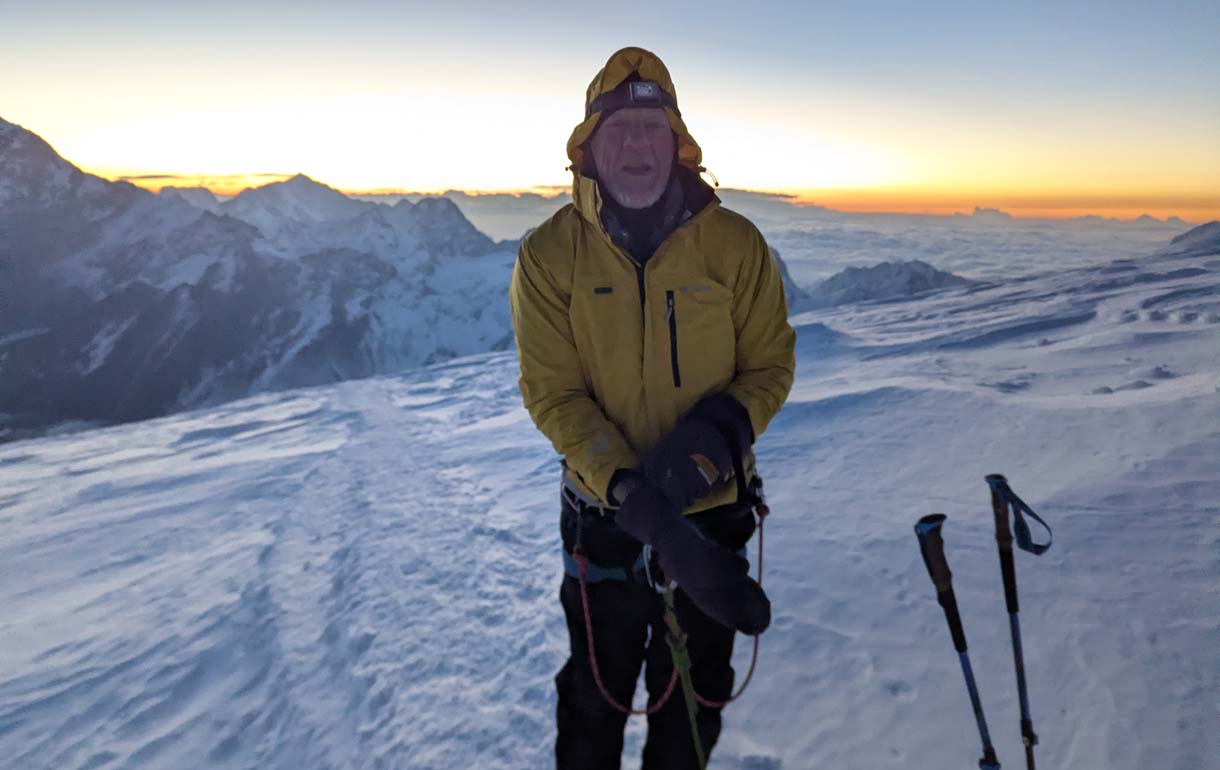
Exclusive Interview with William Rouse: Trekking to EBC at 73 and Summiting Mera Peak at 74
Q. Could you tell us a bit about your background before your Himalayan adventures?
William: I spent my career in the Northwest Territories of Canada, doing a variety of jobs including many years of forest fire fighting, and as a government environmental inspector, but the last 20+ years as a lawyer in both private practice and for government. Once I retired, I traded my desk for the high trails, looking for physical and mental challenges worthy of this next chapter of life.
Q. William, reaching Everest Base Camp in your seventies and summiting Mera Peak at 74 is a remarkable accomplishment. What drove you to pursue these high-altitude goals?
William: Throughout my career and especially while practicing law, I was simply too busy to commit the time, discipline, and singular focus required for expedition-style adventures. Once I retired, I deliberately looked for something that would truly test my limits. High-altitude Himalayan trekking demanded complete focus and preparation. It immediately had my full attention.
Q. Many people believe that high-altitude trekking and peak climbing are only for younger generations. How did you prepare your mind and body for these challenges, and what role did age play in your preparation?
William: I think age and the way you view yourself are very personal issues. As they say, age is only a number, and if you ignore your chronological age and concentrate on how you actually feel, there should be very little need to put limitations on yourself, and you can continue to undertake challenging activities as long as that feeling remains.
Q. Walking all the way from the lower hills up to EBC gives your body more time to adapt. Did you find this gradual approach helped you build endurance for your later climb on Mera Peak?
William: I’m not sure of the physiology of building endurance for high-altitude trekking and climbing over multiple seasons, but in my case, I did not have any problems related to altitude on either the EBC or Mera treks. Having said that, it may in fact be that this gradual approach helped with my endurance, because of the success achieved.
Q. Crossing over from trekking into high-altitude peak climbing is a big leap. What was going through your mind during the final summit push from High Camp to the top of Mera Peak?
William: That’s a good question. In these types of endeavors, where you may be half asleep, perhaps exhausted, and cold, you have to be able to switch into a sort of automatic pilot mode which just forces you out of your warmish sleeping bag at 2:00 AM into the dark and cold, gets you putting on your gear and heading out into the dark, windy, frigid morning and putting one foot in front of the other for 4 to 5 hours straight uphill till the sun breaks and you can see your goal.
If you have never done this sort of thing in other endeavors in your life, you may find it a bit challenging, because your conscious mind may be telling you one thing (that you have already gone far enough, and that it’s cold, and maybe it’s too much for you), but at the same time you are getting out of the bag, putting on your gear, and starting up the mountain, because that’s just what you do.
Q. Can you describe the feeling when you finally reached the summit of Mera Peak and looked out at the panoramic Himalayan giants?
William: It’s a feeling that isn’t easily translatable to words. It really has to be experienced. One can look at all of the videos on the different platforms which show this magnificent view, but it’s even more magnificent when you realize you actually succeeded in getting to the top, with an amazing amount of sacrifice and hard work, which just adds another dimension to the beautiful panorama in front of you.
Q. You spent weeks on the trail with our guide Ganesh, your porter, and your climbing Sherpa. How vital was their support to your safety and comfort?
William: Expedition trekking in the Himalayas is impossible without a dependable team. Ganesh handled the daily route logistics and tea-house management seamlessly, and Suroj carried the heavy load with quiet strength, leaving me free to concentrate entirely on pacing, rhythm, and staying healthy. On the upper mountain, Sange Sherpa was indispensable. His mountain judgment, technical roping, and sharp eye for hazards and crevasse management gave me complete confidence on the glacier. When you trust your team implicitly, you climb better.
Q. What would you say to other senior travelers who wonder if high-altitude Himalayan trekking is still possible for them?
William: If you are in decent physical shape, have perseverance, common sense, and are not afraid of a little discomfort, you can likely succeed in adventures like Mera Peak, EBC Trek, or any of the other treks in the Himalayas. Forget about that number that has been assigned to you!
5 Key Takeaways for Senior Trekkers Dreaming of the Himalayas
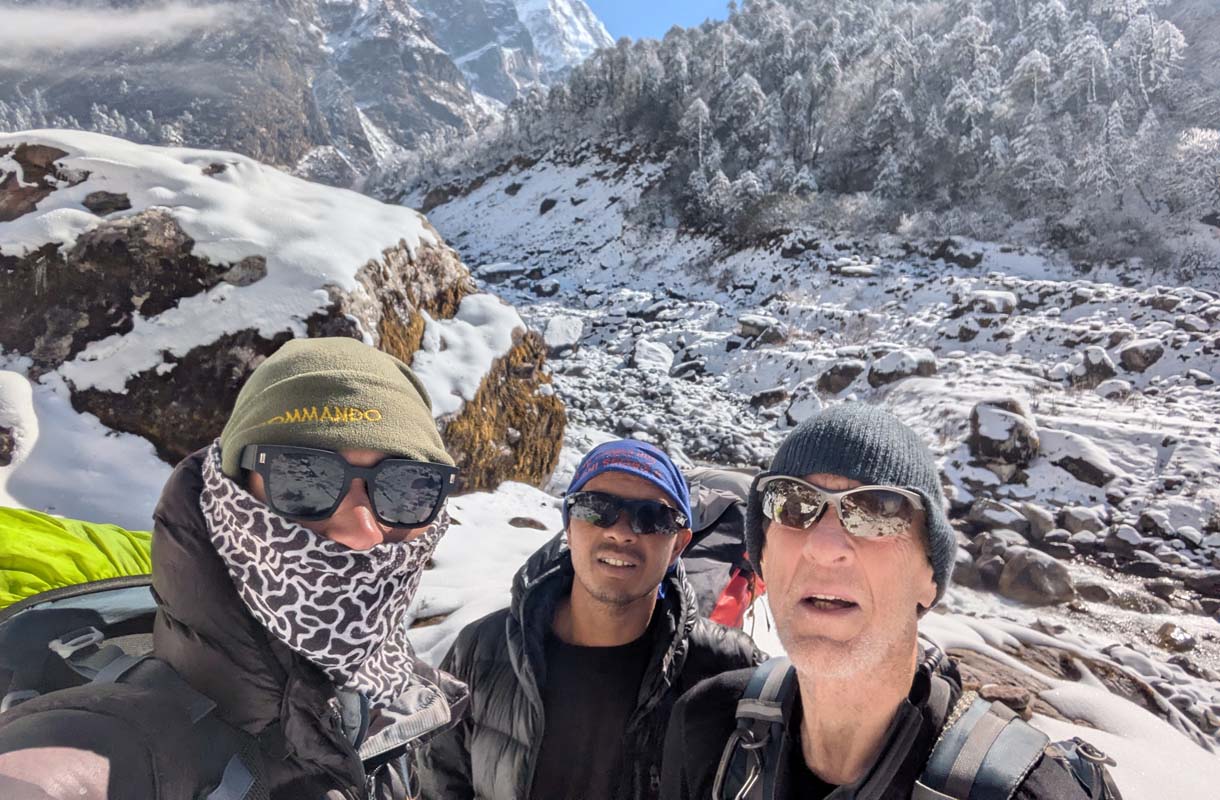
William’s reflections highlight a crucial truth about high-altitude mountain travel: success above 5,000 and 6,000 meters rarely belongs to the fastest person on the trail. It belongs to the steadier, more patient traveler. Here are five practical lessons any older adventurer can apply to their own Himalayan trekking plans.
1. Prioritize Gradual Ascent Over Speed
Altitude illness can affect anyone, regardless of age or fitness, and a steady pace is the best defense. Many guides notice that older trekkers often pace themselves more sensibly than those who rush uphill. Choosing an overland approach to Everest Base Camp, or adding extra acclimatization days in Namche Bazaar, Dingboche, or Khare, gives your body time to adapt safely to thinner air.
2. Train for Consistency, Not Sprints
You do not need to be an elite athlete to trek in Nepal, nor do you need to have climbed mountains your whole life. Consistent cardiovascular training (brisk incline walking, stair climbing with a daypack, hiking uneven trails) plus basic leg and core strength work prepares your joints and lungs for consecutive 5-to-7-hour days on the trail.
3. Master the “2:00 AM Mindset”
Summit mornings on peaks like Mera Peak test mental resolve far more than raw speed. Learning to stay calm when you are cold, tired, and moving slowly in the dark, focusing only on the next breath and the next step rather than the whole mountain, turns an intimidating climb into a series of manageable moments.
4. Invest in an Experienced Local Team
As William emphasized, trusting your trekking guide, porter, and climbing Sherpa transforms the entire experience. A knowledgeable local guide monitors your pacing and oxygen saturation, a dedicated porter protects your energy for the climb ahead, and a certified climbing Sherpa manages ropes, crevasse safety, and weather windows on the glacier.
5. Embrace Discomfort as Part of the Reward
Teahouses in the high Himalayas are warm and welcoming, yet life above 4,500 meters still comes with chilly nights, simple meals, and early wake-up calls. Accepting minor discomfort as part of the adventure keeps frustration low and gratitude high, and it makes the sunrise view of Everest, Lhotse, Makalu, Cho Oyu, and Kanchenjunga from the summit of Mera Peak unforgettable.
Ready to Write Your Own Himalayan Chapter?
William Rouse’s journey from a Canadian law office to Everest Base Camp at 73 and the 6,476-meter summit of Mera Peak at 74 is a powerful reminder that the mountains do not ask for your birth certificate. They only ask for your preparation, humility, and determination.
Whether you want to experience the Everest Base Camp trek without Lukla flights for a calmer, deeper journey through the Solukhumbu valleys, or you have your sights set on standing atop Mera Peak with a trusted local guide and climbing Sherpa team, your next great adventure may still be ahead of you.
Inspired by William’s story? Contact our team to start planning a custom-paced Everest Base Camp or Mera Peak expedition tailored to your goals and timeline.


