
Here’s something that surprises a lot of first-timers: you cannot see the summit of Mount Everest from Base Camp itself. The Nuptse wall and the Khumbu Icefall sit right in the way, blocking the view. That doesn’t make it any less of a milestone, though: standing at 5,364 m (17,598 ft), Base Camp is still one of the highlights of the whole trek.
The climb from Gorak Shep to Kala Patthar (5,545m) is the one final push of the trek, which rewards you with a classic, panoramic view of Mount Everest towering over the Himalayas.
Standing at 5,545 meters (18,192 ft), Kala Patthar is widely recognized as the ultimate viewpoint for witnessing Mount Everest in its full glory. While reaching Everest Base Camp puts you right at the edge of the Khumbu Icefall, the summit itself is hidden behind Nuptse. That is why almost every classic Everest Base Camp Trek package includes a early morning or sunset climb to Kala Patthar to capture that iconic, unobstructed panorama.
Below, we’ve broken down the route section by section with tables and lists covering elevation, timing, and the gear you’ll actually need.
Table of Contents
Why You Need to Visit Both EBC and Kala Patthar ?
Both are highlights of the trek, but they’re not there for the same reason. Everest Base Camp puts you at the foot of the world’s highest mountain, right in the middle of the glacier and the buzz of an actual expedition site. Kala Patthar is different; it’s the viewpoint you need to actually see Everest’s summit, which you can’t do from Base Camp itself.
The EBC is about the journey, history, and mountaineering experience, while Kala Patthar offers a breathtaking sunrise and sunset view over Mt. Everest and the surrounding peaks. Visiting both gives you the best of both experiences.
The table describes the features of EBC and Kala Patthar.
| Feature | Everest Base Camp (EBC) | Kala Patthar |
| Elevation | 5,364 m / 17,598 ft | 5,545 m – 5,644 m / 18,192 ft – 18,519 ft |
| Mt. Everest Summit View | Completely blocked by Mt. Nuptse | Clear, direct, panoramic view |
| Terrain Type | Glacial moraine and rock/ice debris | Steep, rocky dirt switchbacks & boulder ridge |
| Main Highlight | Standing at the historic expedition base | Iconic photography of Everest’s summit |
| Round-Trip Duration | 4.5 – 6 hours (from Gorak Shep) | 3.0 – 4.5 hours (from Gorak Shep) |
Elevation & Distance Quick Reference
Gorak Shep (5,164 m) is the last stop before both pushes; you’ll base yourself here for the hikes to both EBC and Kala Patthar.
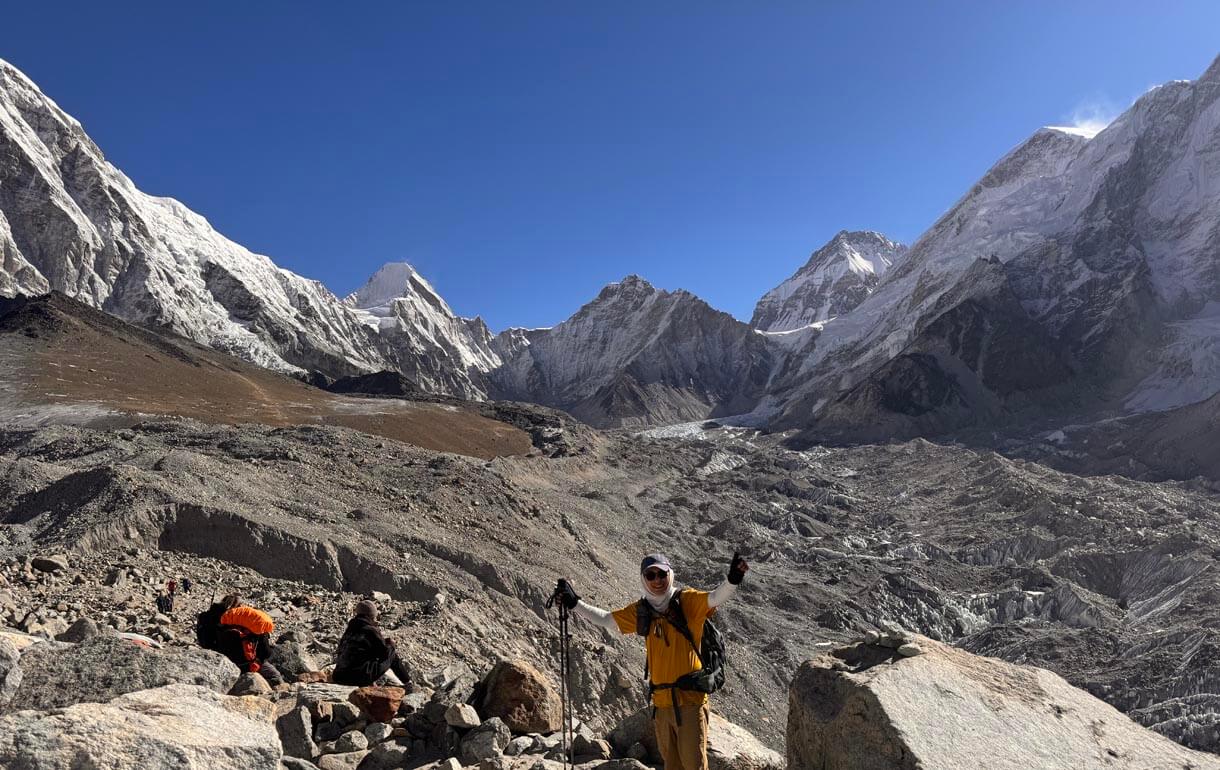
Everest base camp situated at an elevation of 5,364 meters, while Kala Patthar stands at 5,644 meters (18,519 ft). The distance from Gorakshep to Everest Base Camp is 3.5 KM and the distance from Gorakshep to Kala Patthar is only 2 km. So, the total distance between EBC and Kala Patthar is 5.5 KM (3.4 miles).
Elevation gain and distance are in the table.
| Distance | Elevation Gain | |
| Gorakshep to EBC | 3.5 km (2.1 miles) one-way | 200 meters net gain |
| Gorakshep to Kala Patthar | 2 km (1.2 miles) one-way | 480 meters net gain |
| Everest Base Camp to Kala Patthar | 5.5 KM (3.4 miles) | 280 meters net gain |
Step-by-Step Route: How the Final Push Works
Most itineraries split the two hikes across separate days, using Gorakshep as your base. In that way, you’re not trying to do both in one exhausting push, and you can take time for each one to hit the landmark when it’s actually worth seeing.
Day 1 Timeline (EBC Push)
- Morning (7:30 AM – 11:30 AM): Hike from Lobuche (4,940m) across lateral moraine trails to Gorak Shep (5,164m).
- Midday (11:30 AM – 12:30 PM): Check into the teahouse, leave heavy bags, and eat a high-carb lunch.
- Afternoon (12:30 PM – 05:30 PM): Hike 2.5 hours along the glacier to reach EBC (5,364m), spend 45 minutes exploring, and trek back to Gorak Shep.
Day 2 Timeline (Kala Patthar Ascent & Descent)
- Pre-Dawn (04:00 AM – 06:00 AM): Climb up Kala Patthar switchbacks using headlamps.
- Morning (06:00 AM – 07:45 AM): Watch sunrise light up Everest, capture photos, and descend to Gorak Shep.
- Late Morning (08:00 AM – 10:00 AM): Eat breakfast at Gorak Shep and descend safely to a lower altitude at Pheriche (4,370 m).
Sunrise vs. Sunset at Kala Patthar: Which is Better?
Sunset is better than the sunrise from Kala Patthar for photography and lighting, while sunrise offers better sky clarity. Because Mount Everest sits directly east of Kala Patthar, sunrise places the sun behind Everest, casting the peak in deep shadow and creating intense backlight glare. At sunset, the setting sun shines directly onto the western face of Everest, producing a glowing golden alpenglow effect across the summit.
Whether you choose a morning or evening climb, proper acclimatization built into your guided Everest Base Camp trekking itinerary ensures you have the stamina for this steep 5,545-meter ascent.
After taking in the sunrise or sunset views from Kala Patthar, trekkers face a long multi-day descent back through the Khumbu Valley. If you are short on time or wish to avoid the hard knee-pounding trek back down, you can upgrade your trip with an Everest Base Camp trek with helicopter return, taking a direct fly-back from Gorak Shep to Lukla or Kathmandu.
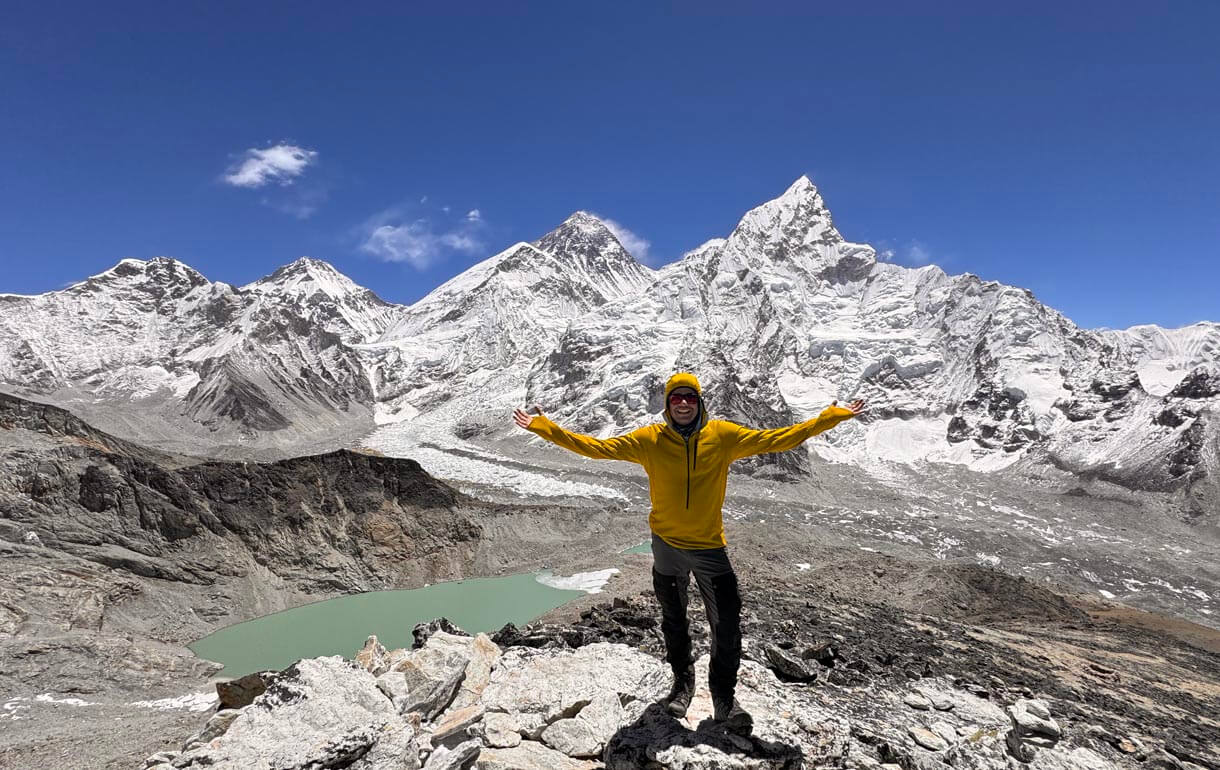
Note: If the afternoon weather is clear, climb for sunset to catch the classic golden glow on Everest’s peak. If clouds roll in during the afternoon, pivot to a sunrise climb the following morning for the guaranteed clear skies.
| Factor | Early Morning (Sunrise) | Late Afternoon (Sunset) |
| Visibility Rate | High (~85-90% clear): Mornings offer stable skies. | Moderate (~50-60% clear): Afternoon clouds often roll in. |
| Temperature | Extremely Cold: Drops to -15°C to -20°C in dark hours. | Manageable: -5°C to -10°C during late afternoon starts. |
| Photography | Direct daylight on Everest’s eastern face. | Legendary golden “alpenglow” on Everest’s peak. |
| Safety Factor | Requires climbing up in the dark with headlamps. | Requires descending in twilight/dusk. |
How strenuous is the Hike Up Kala Patthar?
Although Gorakshep is only two kilometers away, the trek up Kala Patthar is exceptionally demanding because of the high altitude and continuous steep elevation gain. At over 5,000 meters, oxygen levels drop to 50% of sea level due to lower atmospheric pressure, making every step significantly harder.
The hike from Gorakshep to Kala Patthar is through a rocky, uneven trail and requires a steady pace
To tackle this terrain safely, the essential pacing strategy is to maintain a slow pace, take short breaks, and follow your guide’s advice.
Essential Gear for the Kala Patthar Climb
Trekkers should prepare all the required gear for the Kala Patthar hike before sleeping and leave the duffel bag at teahouse in Gorakshep.
Packing the right gear can make your Kala Patthar climb more comfortable, warm, and safe. You should pack a headlamp, down jacket (-10 to -20 degrees), trekking pole, water bottle and windproof gloves etc. Check the gear list below.
· Warm layered clothing – Base layer, fleece, and insulated down jacket.
· Warm trekking pants – Preferably wind-resistant or insulated.
· Warm hat, gloves, and neck gaiter – Useful for the cold and strong wind.
· Sturdy trekking boots – Comfortable, broken-in boots with good grip.
· Wool or thermal socks – Carry an extra pair in case your feet get wet.
· Sunglasses – Protect your eyes from bright sunlight and snow glare.
· Sunscreen and lip balm – High-altitude UV exposure can be strong even on cloudy days.
· Headlamp – Essential as you start the hike before sunrise.
· Trekking poles – Helpful on steep and uneven sections, particularly during the descent.
· Water bottle or hydration system – Stay hydrated throughout the hike.
· Small daypack – Carry only the essentials to keep the climb comfortable.
· Camera or smartphone – For capturing the spectacular Himalayan scenery.
Plan Your Everest Adventure with Glorious Himalaya
Reaching a high-altitude milestone like Kala Patthar takes real preparation, a careful pace, and someone watching your safety the whole way. That’s what our certified local guides handle — they manage the teahouse logistics in Gorak Shep, check your oxygen levels with a pulse oximeter every day, and keep an eye on trail safety, so all you have to focus on is getting to that viewpoint.


