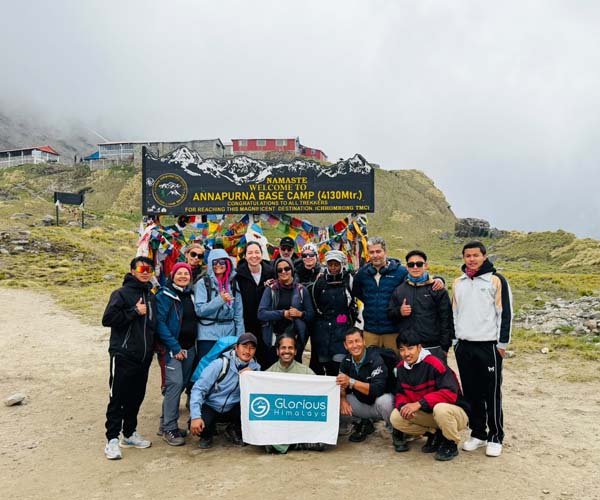
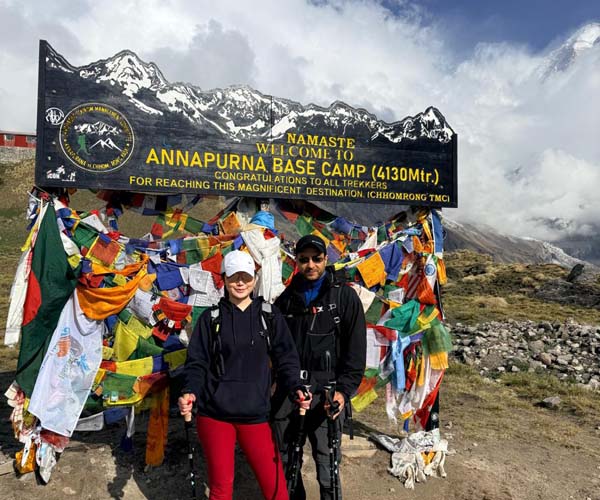
The Annapurna Base Camp Trek is one of the most rewarding walks in Nepal, taking you deep into the Himalayas. Reaching a maximum elevation of 4,130 meters (13,549 ft) at the Annapurna Base Camp height, this iconic journey leads you directly into the spectacular Annapurna Sanctuary—a soaring glacial basin completely surrounded by a 360-degree of towering, snow-capped peaks.
This route is also called the ABC Trek Nepal or the Annapurna Sanctuary Trek, and both names mean the same journey. The sanctuary is a wide, rocky basin, and a ring of tall mountains rises around its edge. Annapurna I is the 10th highest in the world at 8,091 m, and Annapurna South, Hiunchuli and Machhapuchhre, or Fishtail, stand beside it.
Our ABC trek itinerary lasts 10 days. You spend 6 days walking in the mountains and sleep 5 nights in local teahouses. The other days are spent in Kathmandu and Pokhara, with hotel stays and transfers by tourist bus and private jeep. The journey begins with a warm welcome from our team in Kathmandu. Next day, your journey starts with a scenic tourist bus drive from Kathmandu to Pokhara, the vibrant lake city that serves as the gateway to the Annapurna region. The next morning, a private jeep drives you to Jhinu Danda, where the walking begins. You cross a long suspension bridge over the Modi Khola River, then climb stone steps to Chhomrong, a Gurung village.
From Chhomrong, the trail follows the river valley through farmland, bamboo forest and rhododendron woods. You spend nights in Dovan and Deurali, and the air becomes cooler and thinner as you gain height. Next, you pass Machhapuchhre Base Camp (MBC), which sits right below the sharp peak of Fishtail. A few more hours of steady walking bring you to Annapurna Base Camp, where you stay overnight. Early the next morning, you watch the sun rise over the surrounding peaks and light up the snow.
On the way down, you stop again at Jhinu Danda, where a short path leads to the natural hot springs. A warm soak here relaxes your tired legs and gives you a gentle end to the trek.
The whole trek lies inside the Annapurna Conservation Area, so a conservation permit is part of your trekking paperwork. Within a few days, the scenery changes from warm terraced farmland to cool bamboo forest, then open alpine meadows, and finally rock and ice near base camp. Along the way, you can also spot Dhaulagiri and Nilgiri on clear days. The trail passes through Gurung villages, where slate-roofed houses, prayer flags and home-cooked dal bhat show the everyday mountain way of life.
When evaluating Annapurna Base Camp difficulty, the trek is rated as moderate in difficulty. Walking 5 to 7 hours per day over stone steps and well-defined trails requires reasonable physical fitness, but no technical climbing or prior trekking experience is necessary.
Our 10-day itinerary is designed with gradual elevation gains to ensure proper altitude adjustment. For your safety, our licensed mountain guides carry a comprehensive first-aid kit and pulse oximeters to monitor your oxygen levels and heart rate daily.
The best time for the Annapurna Base Camp trek is spring (March to May) or autumn (September to November). In spring, rhododendrons bloom across the hillsides and the weather stays mild for walking. In autumn, the skies are clear and the mountain views are at their sharpest. Winter brings cold and snow, while the summer monsoon makes the trail wet and slippery.
Since 2011, Glorious Himalaya has safely guided trekkers across the Himalayas. Led by certified local guides, our all-inclusive 10-day ABC package handles all logistics—including permits, accommodation, meals, and transport—so you can focus entirely on enjoying your journey.